
Blog
What hiring a Canadian developer really costs compared with a U.S. hire
How to compare the cost of a Canadian developer with a U.S. hire on a fully loaded basis: salary, employer contributions, benefits, exchange rate and the Employer of Record fee, and why savings of 10–40% are typical rather than guaranteed.
Published November 20, 2025 · Updated October 21, 2026
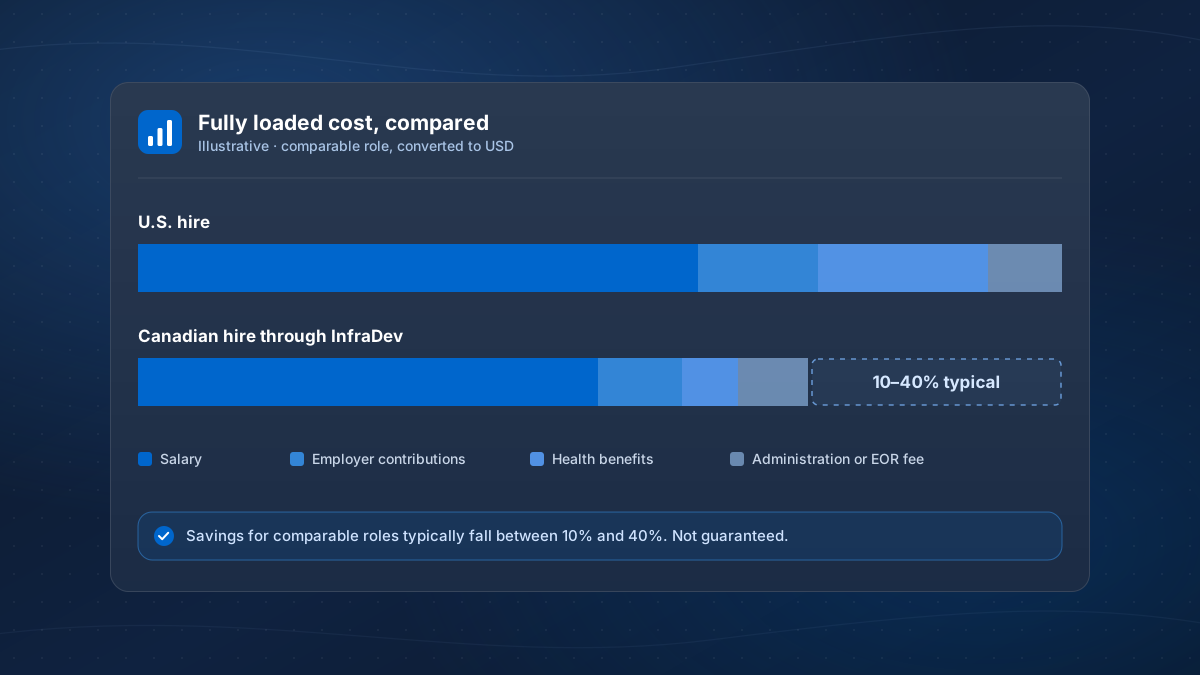
U.S. companies hiring developers in Canada usually spend less per person than they would for a comparable U.S. hire. For comparable roles, the difference typically falls between 10% and 40% on a fully loaded basis. That range is wide because the answer depends on the role, the two cities you are comparing, and how you count. This article explains what to include so your comparison holds up.
Compare fully loaded cost, not salary
Base salary is the biggest line, but it is not the whole cost. Build both sides the same way:
| Cost line | U.S. hire | Canadian hire through an EOR |
|---|---|---|
| Base salary | In USD | In CAD, converted at the rate you budget |
| Employer social contributions | Social Security, Medicare, FUTA, state unemployment | CPP or QPP, EI, and any provincial employer health tax |
| Workplace injury insurance | State workers’ compensation | Provincial workers’ compensation premiums |
| Health benefits | Employer share of health insurance, often the largest benefit cost | Supplementary health and dental plan; core health care is public |
| Retirement | 401(k) match, if offered | RRSP or group plan match, if offered |
| Paid time off | Company policy | Statutory vacation and holidays, plus any policy above them |
| Employment administration | Payroll, HR and compliance staff or vendors | Included in the Employer of Record fee |
Canadian employer contribution rates change every January, so take them from the CRA’s CPP and EI pages at the time you budget.
Where the difference comes from
- Salary levels. Developer salaries in Canadian tech hubs are generally lower than in comparable U.S. markets. The gap is largest against high-cost U.S. cities and smallest against lower-cost U.S. regions.
- Health benefits. Because core health care is public in Canada, employer health plans cover supplementary care and usually cost less than U.S. employer health insurance.
- Exchange rate. Salaries are paid in Canadian dollars. A stronger U.S. dollar widens the gap; a weaker one narrows it. Budget at a conservative rate.
Some lines work the other way. Statutory vacation and holidays are minimums, Québec employees carry QPP and QPIP rather than CPP and the EI parental benefit, and the Employer of Record fee is a cost a U.S. hire doesn’t have, though it replaces the cost of setting up and running a Canadian entity.
A worked approach
- Pick the role and level, and the U.S. city you would otherwise hire in.
- Get salary data for both markets from a current salary survey or recruiter, for the same level of experience.
- Add employer contributions and benefits on each side using the table above.
- Convert the Canadian total to USD at your budget rate.
- Add the Employer of Record fee to the Canadian side, or entity costs if you would hire directly.
- Compare, and test the result at a less favourable exchange rate.
Our Canada vs U.S. hiring costs comparison walks through an illustrative senior-developer example.
What doesn’t change
Cost is one reason U.S. companies hire in Canada, but rarely the only one. Most Canadian developers work in the same time zones as U.S. teams, use the same stacks and tools, and work in English (often French as well), so they can join existing teams without a different operating model. See why Canada for tech talent.
Getting a number for your role
Savings vary by role and location and are typical, not guaranteed. If you tell us the role, level and province, we can show you the fully loaded cost of employing that person through our Employer of Record service, so you can put it next to your U.S. figure. Request pricing.
Next steps for hiring in Canada
-
How it works
The steps from your chosen candidate to their first payroll, and who does what.
-
Employer of Record
How InfraDev employs your hire in Canada so you don’t need a Canadian entity.
-
Compare your options
EOR, your own Canadian entity, or contractors: cost, timeline and risk.
-
Hiring in Canada guide
Payroll, CRA registration and employment law for U.S. companies.
Planning a hire in Canada?
Tell us the role and province. We'll explain how employment, payroll and compliance would work for your team.