
Blog
How to hire employees in Canada as a U.S. company (2026 guide)
A U.S. company can hire in Canada in three ways: open a Canadian entity, engage contractors, or use an Employer of Record (EOR) that employs the person for you. For a first hire or a small team, an EOR is usually the fastest compliant route: no entity to form, and a start within 24–48 hours of terms being agreed.
Published April 11, 2026 · Updated October 21, 2026
Can you hire in Canada without a Canadian company?
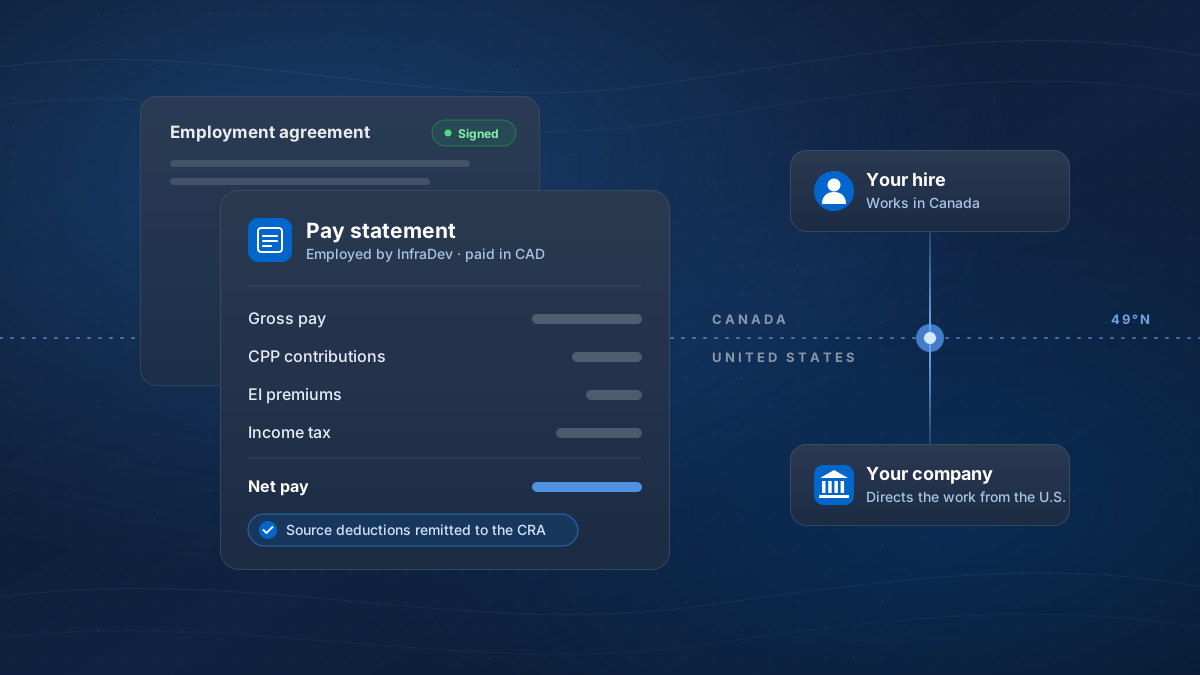
Yes. Under an Employer of Record arrangement, the EOR is the legal employer in Canada: it signs the employment contract, runs payroll, remits deductions to the Canada Revenue Agency (CRA), and applies the employment standards of the employee's province. Your company chooses the person, sets the role and pay, and directs the daily work.
The two alternatives are opening your own Canadian entity or engaging the person as an independent contractor. Each suits a different situation.
Your three options
1. Open a Canadian entity
Hiring directly through your own Canadian company typically involves:
- Incorporating federally or in a province, and registering extra-provincially where you operate.
- Getting a business number and a CRA payroll program account (plus Revenu Québec registration in Québec).
- Registering with the workers' compensation board in each province where people work.
- Running payroll, remitting deductions on the CRA's schedule, and filing T4 slips each February.
- Writing employment contracts that meet each province's minimum standards.
Expect weeks to months before payroll runs smoothly, legal and accounting costs up front, and ongoing responsibility for compliance. An entity makes sense for a large, permanent Canadian team; for one to a few hires it is rarely the fastest route. See EOR vs Canadian entity for cost and break-even.
2. Engage contractors
Contracting looks simple, but Canadian authorities decide employee or contractor status by how the work is done, not by the contract. If you control the work, supply the tools, carry the financial risk, and the person is integrated into your team, they are likely an employee, and you are exposed to unpaid source deductions, penalties, and employment standards claims. The CRA explains the test on its employee or self-employed page. For genuinely independent work, our consulting management service handles the contract, invoicing and tax forms.
3. Use an Employer of Record
The EOR handles:
- The Canadian employment contract
- Payroll, source deductions and remittances
- Statutory and agreed benefits, vacation and holiday pay
- Year-end slips and employment records
Your company keeps:
- The hiring decision, role and compensation
- Day-to-day direction, priorities and performance
- Integration into your team and tools
The options side by side
| Factor | Employer of Record | Your own entity | Contractor |
|---|---|---|---|
| Time to first hire | 24–48 hours after terms are agreed | Weeks to months | Days |
| Legal employer | The EOR | Your Canadian company | None (business-to-business) |
| Payroll and compliance | Run by the EOR | Your responsibility | The contractor's responsibility |
| Misclassification risk | None: the person is an employee | None if run correctly | High for full-time, directed roles |
| Best for | First hires, small teams, testing the market | Large, permanent teams | Short, independent projects |
What Canadian law requires of an employer
Whoever the employer is, these obligations apply:
- Source deductions. Federal and provincial income tax, Canada Pension Plan (Québec Pension Plan in Québec) and Employment Insurance, withheld each pay and remitted with the employer's share. Rates and maximums change every January: see the CRA's CPP and EI pages, or our Canadian payroll guide.
- Provincial employment standards. Minimum wage, vacation, statutory holidays, overtime and termination notice differ by province. See employment law basics.
- Workers' compensation. Registration and premiums with the board in the province where the employee works, including for remote workers.
- Year-end slips and records. T4 slips (and RL-1 slips in Québec) by the last day of February, and payroll records kept for six years. See CRA requirements.
How hiring through an EOR works
- You choose the candidate and set the role, pay and start date.
- We agree terms with you and confirm the province, benefits and any office requirements.
- We issue the employment contract, written to that province's standards, and collect the employee's tax forms.
- The employee starts, usually within 24–48 hours of terms being agreed, and is added to our payroll.
- Each month you receive one invoice covering salary, employer contributions and our fee, while you direct the work.
What it costs
Compare the two routes on total cost, not salary alone. The entity route adds incorporation, accounting, payroll software or a provider, and the time your team spends on compliance. The EOR route adds a predictable monthly fee per employee. Against comparable U.S. hires, Canadian employment costs typically run 10–40% lower (typical, not guaranteed); Canada vs U.S. hiring costs walks through the components. For our fee, request pricing.
When an EOR fits, and when an entity does
An EOR usually fits when you are:
- Making your first hires in Canada, or building a small team
- Testing the Canadian market before committing to an entity
- Hiring on a deadline
- Converting a contractor whose role has become employment
Your own entity becomes worth the setup when the Canadian team is large and permanent, when you need a Canadian presence for contracts or customers, or when you are investing in Canadian operations. Starting with an EOR and opening an entity later is a common path.
Frequently asked questions
Common questions from U.S. companies making their first Canadian hire.
Can a U.S. company hire employees in Canada without a Canadian entity?
Yes. An Employer of Record (EOR) such as InfraDev employs the person in Canada, runs payroll and remittances, and applies provincial employment law, while your company directs the day-to-day work. You do not need to incorporate, register a CRA payroll account, or run Canadian payroll.
How long does it take to hire in Canada through an Employer of Record?
Once you have chosen the candidate and agreed terms, a hire can usually start within 24–48 hours, depending on completed paperwork and the start date you choose. Opening your own entity typically takes weeks to months before payroll runs smoothly.
Can I hire a Canadian as an independent contractor instead?
Only if the work is genuinely independent. The CRA and the provinces look at how the work is done (control, tools, chance of profit or risk of loss, and integration into your business), not at what the contract calls it. A full-time role directed by your managers is usually employment. See EOR vs contractor.
Can I convert an existing Canadian contractor to an employee?
Yes. We can employ a contractor you already work with, so the working relationship stays the same while employment, payroll and benefits move onto a compliant footing.
Next steps for hiring in Canada
-
How it works
The steps from your chosen candidate to their first payroll, and who does what.
-
Employer of Record
How InfraDev employs your hire in Canada so you don’t need a Canadian entity.
-
Compare your options
EOR, your own Canadian entity, or contractors: cost, timeline and risk.
-
Hiring in Canada guide
Payroll, CRA registration and employment law for U.S. companies.
Planning your first hire in Canada?
Tell us the role and province. We'll explain how employment, payroll and compliance would work, and how quickly your hire could start.