
Blog
Hiring an employee in Québec: what U.S. companies should know
What changes when your Canadian hire lives in Québec: French job offers and contracts, payroll through Revenu Québec, Québec labour standards, and Law 25.
Published October 21, 2026
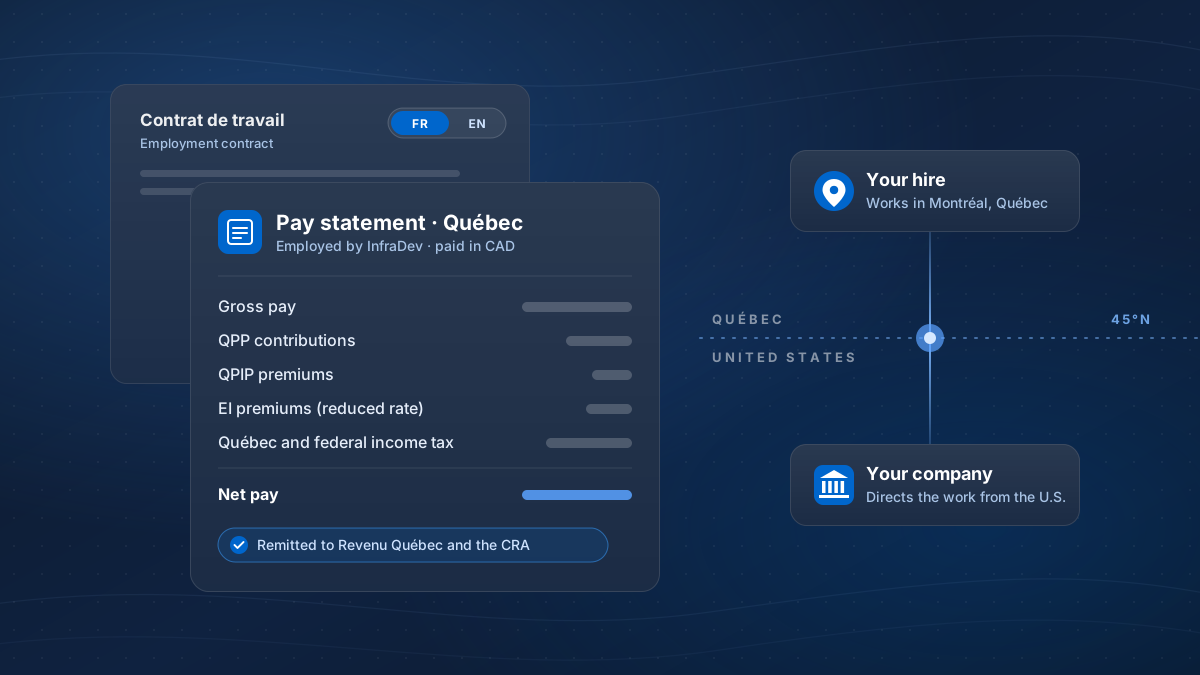
Most of what U.S. companies learn about hiring in Canada applies in Québec too, but four things work differently: the language of work, payroll, labour standards and privacy law. None of them is a reason to avoid a strong candidate in Montréal or Québec City. They are reasons to set up the hire correctly from the first job posting. This article covers each one. For the Canada-wide picture, start with our 2026 guide to hiring in Canada.
French is the language of work
Québec’s Charter of the French language gives employees the right to work in French, and the 2022 amendments (Bill 96) made several employer obligations explicit:
- Job postings. Offers of employment must be published in French. If you also publish in English, the French version must go out at the same time, through comparable channels reaching a comparable audience.
- Employment contracts. A written employment contract must be drawn up in French. The employee and employer can then expressly choose to be bound by an English version, but only after the French version has been provided.
- Requiring English. An employer may require knowledge of a language other than French only when the duties genuinely need it and after taking reasonable steps to avoid the requirement. A posting that requires English must say why. For a role on an English-speaking U.S. team, document the reason: the people the employee works with every day, the clients they serve, the systems they use.
- Day-to-day communication. Written communications to staff and documents about their conditions of employment must be available in French.
Employers with 25 or more employees in Québec must also register with the Office québécois de la langue française and follow its francization process; the threshold dropped from 50 to 25 on June 1, 2025.
None of this stops a team from working in English. It means the paperwork starts in French and the language requirement is justified rather than assumed.
Québec runs its own payroll system
Everywhere else in Canada, the employer remits income tax and contributions to the Canada Revenue Agency (CRA). In Québec, the employer registers with both the CRA and Revenu Québec and remits to each.
| Rest of Canada | Québec | |
|---|---|---|
| Provincial income tax | Withheld with federal tax, remitted to the CRA | Withheld separately, remitted to Revenu Québec |
| Pension plan | Canada Pension Plan (CPP) | Québec Pension Plan (QPP) |
| Employment insurance | Standard EI premiums | Reduced EI premiums, plus the Québec Parental Insurance Plan (QPIP) |
| Employer health contribution | Varies by province | Health Services Fund contribution; the rate depends on total payroll |
| Labour standards | Not applicable | Labour standards contribution, collected by Revenu Québec for the CNESST |
| Training | Not applicable | Employers with total payroll above $2 million spend at least 1% of payroll on eligible training or pay the shortfall to the Workforce Skills Development and Recognition Fund |
| Workplace safety | Provincial board (WSIB, WorkSafeBC and others) | CNESST |
| Year-end slips | T4 | T4 and RL-1, both by the last day of February |
Employees fill in Québec’s own withholding form (TP-1015.3-V) as well as the federal TD1. Rates and maximums for QPP, QPIP and EI change every January, so take them from Revenu Québec and the CRA when you budget. Our Canadian payroll guide covers the federal side.
Labour standards that differ from U.S. practice
Québec’s labour standards are set by the Act respecting labour standards and administered by the CNESST. The points U.S. employers most often get wrong:
- Vacation. Two weeks after one year of service, paid at 4% of gross wages; three weeks after three years, paid at 6%.
- Statutory holidays. Eight paid holidays, including June 24 (Fête nationale) and July 1 (Canada Day). U.S. holidays such as Independence Day and U.S. Thanksgiving are not.
- Sick and family days. After three months of service, employees get two paid days a year for illness or family obligations, within longer unpaid entitlements.
- Overtime. Hours beyond the standard 40-hour week are paid at time and a half, with limited exceptions such as senior managers.
- Harassment policy. Every employer must adopt and make available a psychological harassment prevention and complaint policy, including sexual harassment.
- Ending employment. There is no at-will employment. Written notice of termination ranges from one week (three months to a year of service) to eight weeks (ten years or more), or pay in lieu, and the Civil Code of Québec can require longer, reasonable notice. After two years of uninterrupted service, an employee dismissed without good and sufficient cause can file a complaint within 45 days, and the tribunal can order reinstatement.
Our employment law basics compares these standards with other provinces, and the province explorer lists each province’s governing law and workers’ compensation board.
Privacy: Law 25 covers employee information
Québec’s private-sector privacy law, substantially strengthened by Law 25, applies to the personal information an employer holds about its staff. For an employer, that means:
- A person in charge. The person with the highest authority in the business is responsible for protecting personal information. They can delegate the role in writing, and the title and contact details must be published on the company’s website.
- Confidentiality incidents. Incidents must be recorded, and those that present a risk of serious injury reported to the Commission d’accès à l’information and to the people affected.
- Transfers outside Québec. Before personal information is communicated outside Québec, for example to a U.S. HR or payroll system, the employer assesses whether it will be adequately protected.
In practice, check where employee records will live and who can see them before the first day of work.
How an Employer of Record handles Québec
Through an Employer of Record, the EOR is the employer, so most of these obligations sit with it: the French employment contract, Revenu Québec and CNESST registration and remittances, RL-1 slips, labour standards, francization and the privacy rules for employment records. InfraDev is based in Beaconsfield, Québec, so these are the rules we work under ourselves. We can also give your Québec hire a desk in our office through Host your hire.
A few things remain on your side:
- Job postings you publish yourself need a French version, released at the same time.
- The language requirement. If the role needs English, agree the reason with us before the offer goes out.
- Your own systems. If the employee’s information flows into your U.S. tools, tell us so the transfer can be assessed.
Summary
| Area | What to do |
|---|---|
| Language | French job postings and contracts; justify any English requirement |
| Payroll | Register with the CRA and Revenu Québec; QPP, QPIP, Health Services Fund, RL-1 |
| Labour standards | Québec vacation, holidays, paid sick days, harassment policy, notice and dismissal rules |
| Privacy | Named person in charge, incident register, assessment before transfers outside Québec |
To see how a Québec hire would work for your team, book a call or read how our Employer of Record service works.
Next steps for hiring in Canada
-
How it works
The steps from your chosen candidate to their first payroll, and who does what.
-
Employer of Record
How InfraDev employs your hire in Canada so you don’t need a Canadian entity.
-
Compare your options
EOR, your own Canadian entity, or contractors: cost, timeline and risk.
-
Hiring in Canada guide
Payroll, CRA registration and employment law for U.S. companies.
Planning a hire in Canada?
Tell us the role and province. We'll explain how employment, payroll and compliance would work for your team.