
Blog
Why U.S. companies use an Employer of Record for Canadian employees
The reasons U.S. companies hire Canadian employees through an Employer of Record instead of opening a Canadian entity: speed, no entity to run, compliance carried by a specialist, one invoice, and the flexibility to change course.
Published November 20, 2025 · Updated October 21, 2026
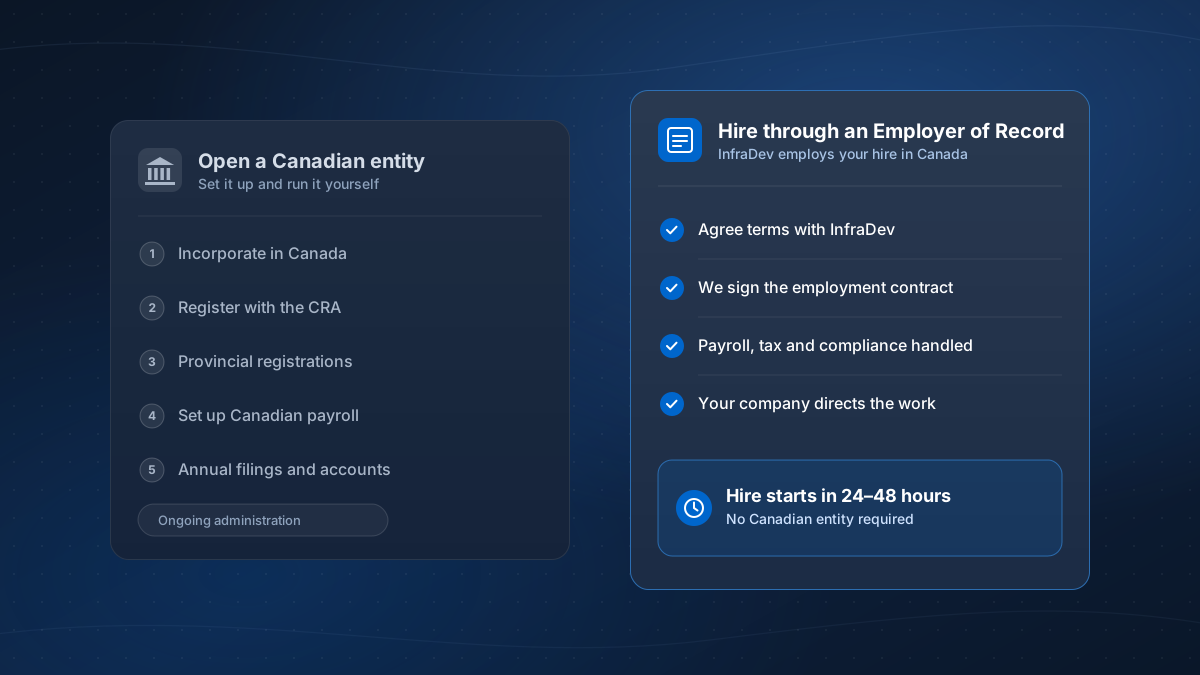
When a U.S. company decides to hire in Canada, the first structural question is whether to open a Canadian entity or use an Employer of Record (EOR) that employs the person on its behalf. For first hires and small teams, most choose an EOR. These are the reasons, and the situations where an entity is the better answer.
Why Canada in the first place
Canada is a natural first international market for U.S. teams: most of the population works in the same time zones as the U.S., English is widely spoken (with French in Québec and elsewhere), business culture and legal concepts are familiar, and the major tech hubs have deep talent pools. For comparable roles, employment costs typically run 10–40% below U.S. equivalents (typical, not guaranteed). See why outsource to Canada.
The reasons companies choose an EOR
1. No entity to set up or run
Hiring directly means incorporating, registering for a CRA business number and payroll account, registering with the provincial workers’ compensation board and, in Québec, with Revenu Québec, and then keeping all of it current. With an EOR, those registrations are the EOR’s. You sign a service agreement and start hiring.
2. Speed
Forming an entity and getting payroll running takes weeks to months. Through an EOR, a hire can usually start within 24–48 hours of terms being agreed. When a strong candidate has competing offers, that difference decides the hire.
3. Compliance carried by a specialist
Canadian employment is governed largely by provincial law, and payroll rules change every January. An EOR applies them as the legal employer:
- Income tax, CPP or QPP and EI withheld and remitted on schedule
- Vacation, statutory holidays, overtime and leave as the province requires
- Employment contracts and termination handled to provincial standards
- Workers’ compensation registration and premiums
- T4 slips, Records of Employment and payroll records
The employee is an employee, so there is no contractor misclassification risk.
4. Predictable cost
An entity has fixed costs whether you employ one person or twenty: incorporation and legal fees, accounting, payroll software or a provider, and the internal time to manage it. An EOR charges a fee per employee. For a small team that is usually the lower and more predictable figure; EOR vs Canadian entity shows where the break-even falls.
5. One invoice
Instead of running Canadian payroll accounts, remittances and benefits vendors, you receive one monthly invoice covering salary, employer contributions and the EOR fee.
6. Flexibility
An EOR lets you add people as the work grows, test the Canadian market before committing to an entity, or staff a fixed-term project, without changing your corporate structure.
Common situations
- A startup’s first Canadian engineer, hired in days instead of waiting on incorporation.
- A company testing a Canadian team before deciding whether to open an entity.
- A contractor whose role has become employment, converted to an employee without changing the working relationship.
- A project team needed for a defined period.
When an entity is the better choice
Consider opening your own Canadian entity when:
- The Canadian team will be large and permanent
- You need a Canadian presence to contract with customers or hold assets
- You are investing in Canadian operations beyond employment
- Your tax or corporate structure calls for it
Starting with an EOR and opening an entity later is a common path.
Next step
If you are weighing the options for a specific hire, our 2026 guide to hiring employees in Canada sets out the steps, or see how our Employer of Record service works.
Next steps for hiring in Canada
-
How it works
The steps from your chosen candidate to their first payroll, and who does what.
-
Employer of Record
How InfraDev employs your hire in Canada so you don’t need a Canadian entity.
-
Compare your options
EOR, your own Canadian entity, or contractors: cost, timeline and risk.
-
Hiring in Canada guide
Payroll, CRA registration and employment law for U.S. companies.
Planning a hire in Canada?
Tell us the role and province. We'll explain how employment, payroll and compliance would work for your team.